
Lulu and the Lost Duckling
A little shrimp helps a lost duckling find its mother. A children’s cartoon, made in VIA from one script.
One story, start to finish.
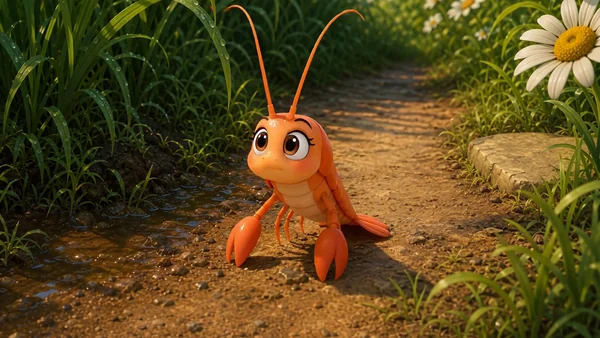
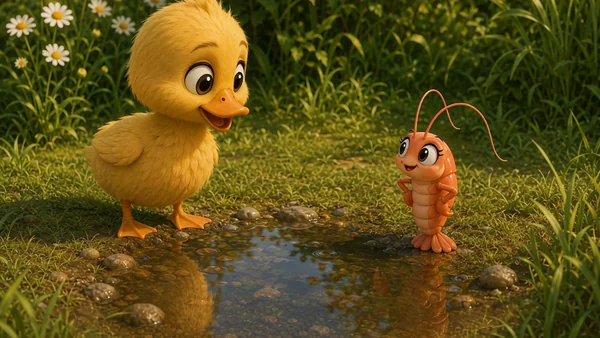
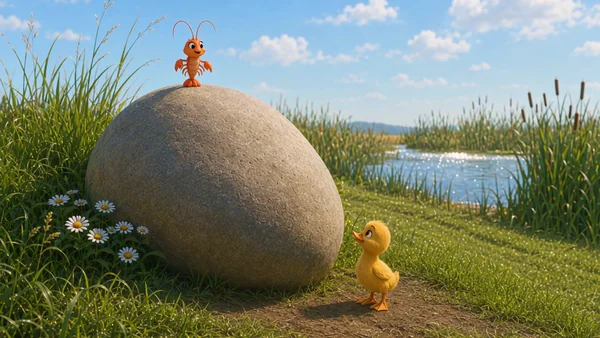
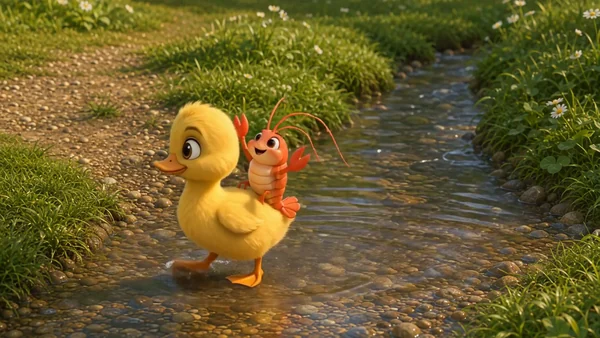
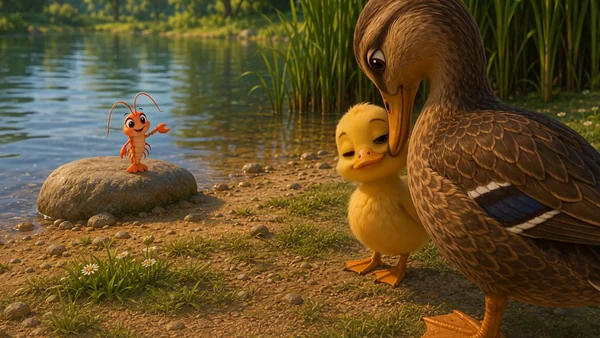
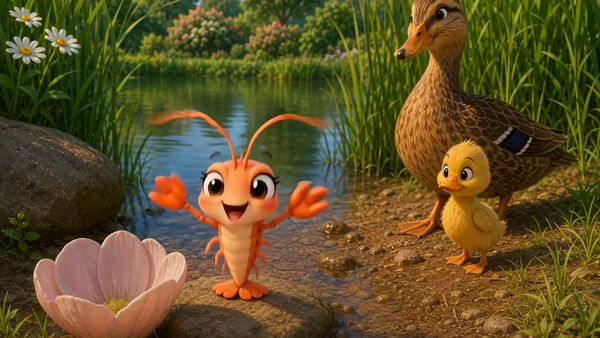
Six moments from the finished film. Same shrimp, same duckling, same garden.
The brief
Lulu is a curious little shrimp. One sunny morning in the garden he finds a duckling who has lost his mama. They search together, chase a false alarm, climb a pebble to look out, cross a stream with Lulu riding on the duckling’s back, and find Mama Duck at the pond. The script mixes a narrator with spoken lines for each character.
Children’s cartoons are unforgiving in a different way from documentaries. A small viewer notices at once when the hero changes colour, when a friend has a different face, or when the garden is suddenly somewhere else. And animals have to move like animals: a shrimp has claws and feelers, not hands.
The cast and the garden, decided once.
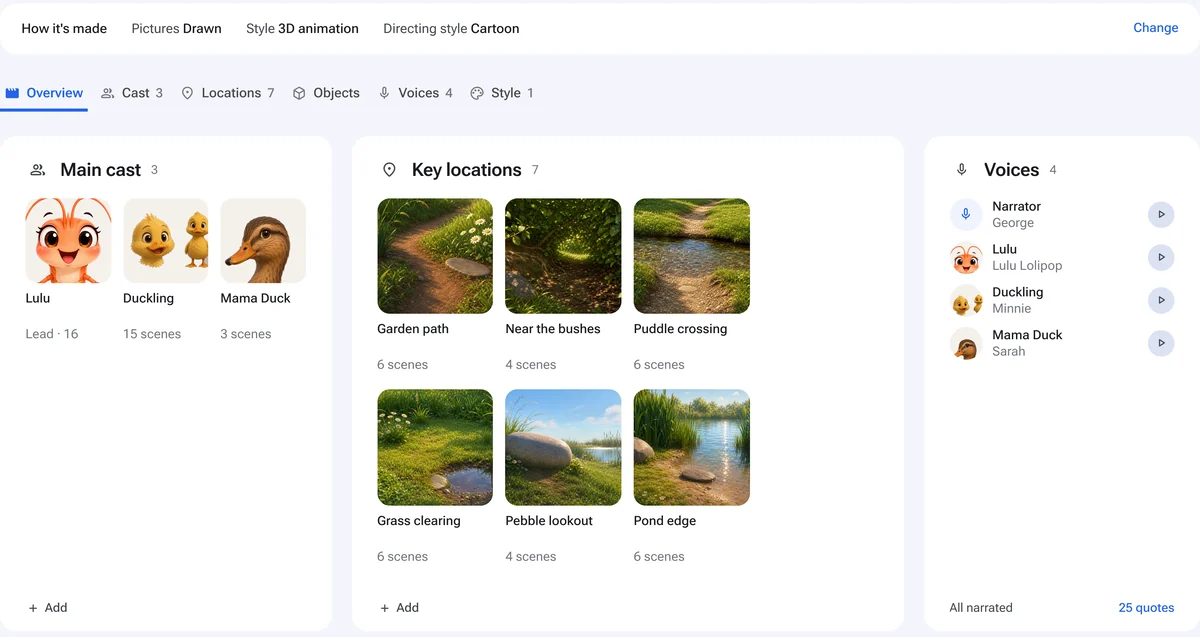
VIA read the script and set up the world before drawing a scene: three characters with their own voices, and the garden’s corners as places the story returns to.
Setup: cartoon look, cartoon directing
The project was set to drawn pictures in a 3D-animation style, with cartoon directing. Each character got one picture used in every scene they appear in, and its own voice: a narrator, Lulu, the duckling and Mama Duck. The garden was set up as one place with six areas (the path, the bushes, the puddle crossing, the clearing, the pebble lookout and the pond edge), so every scene happens in the same garden rather than in six unrelated pictures.
Scenes: the shot follows the words
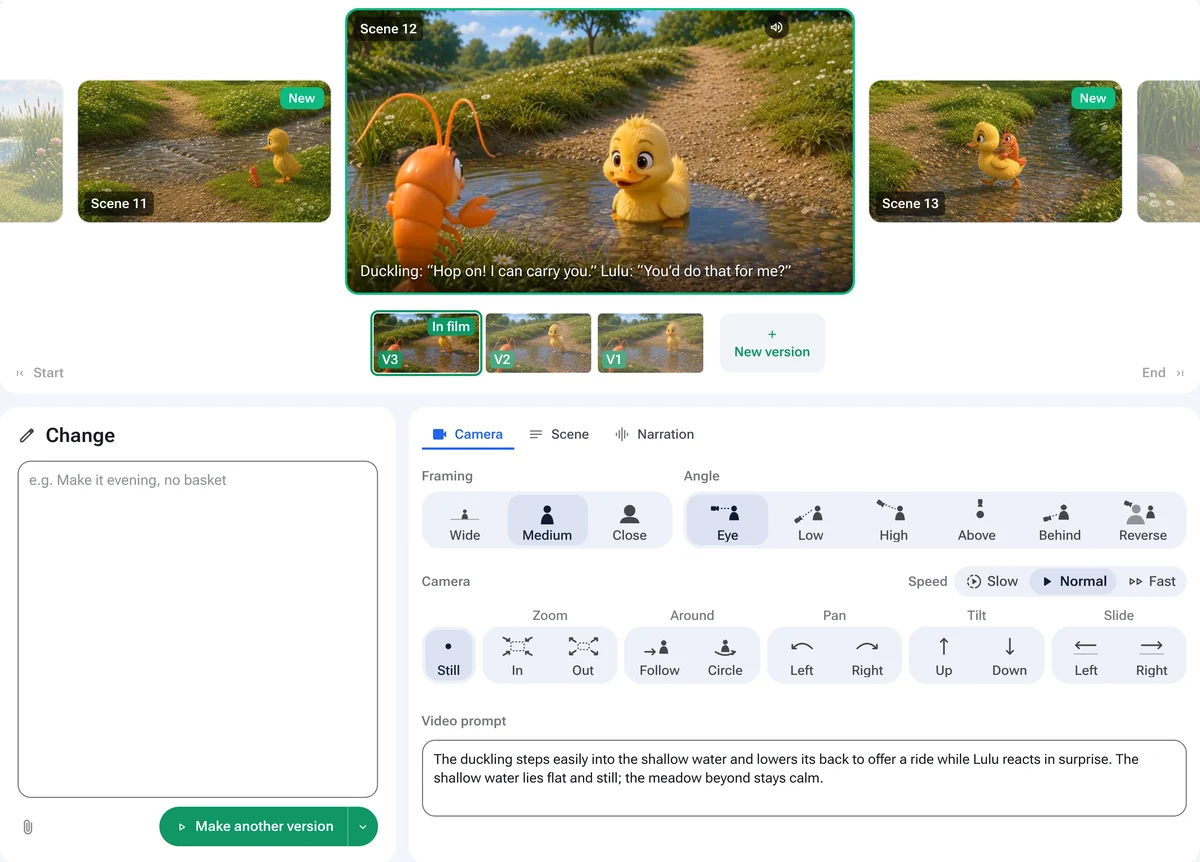
Each scene is tied to its line. When the duckling says “Hop on! I can carry you,” the shot shows him in the shallow water with Lulu beside him. Cartoon directing changes the camera from line to line, close on a face for a feeling, wide for a journey, low when Lulu looks up at something big, the way animated stories for children are filmed.
Anything you do not like you change in plain words, and every version is kept. Below, scene 12 has three versions; the one in the film is marked.
Film: one short, ready to post
The scenes, voices and music were assembled into one film you watch and correct as a whole. At a little over a minute it suits a children’s channel, and the same project can be cut into vertical Shorts.
What it shows
- One studio, any look. The same engine that drew a Roman street draws a shrimp in a garden. The look is a setting, not a different tool.
- Characters stay themselves. One picture per character, used in every scene, keeps a children’s series recognisable episode after episode.
- Voices per character. A narrator and a cast can share one script.
- One world, many corners. A story that moves around one place stays in that place.
See also the kids’ animation use case, and our other test productions: 24 Hours in Ancient Rome and Japan Travel Mistakes.